12.04.2026
6 mins
New Zealand's current fuel supply uncertainty has focused public attention on how much fuel the country has in reserve and how quickly it can be replenished. For individual businesses and farm operators, however, the more immediate question is closer to home: is your on-site fuel storage legally compliant, and what happens if a tank fails or overflows?
Secondary containment — the bunded or lined enclosure that surrounds a fuel storage tank — is not optional for most commercial and agricultural fuel storage in New Zealand. It is a legal requirement under the Health and Safety at Work (Hazardous Substances) Regulations 2017, and the consequences of a failure without it in place can extend well beyond a WorkSafe compliance issue.
The Regulatory Requirement
The Health and Safety at Work (Hazardous Substances) Regulations 2017 require any PCBU (person conducting a business or undertaking) to ensure that a secondary containment system is in place wherever hazardous substances — including diesel and petrol — are stored above defined threshold quantities. For both diesel and petrol, secondary containment is triggered at 1,000 litres.
Above these quantities, a compliant secondary containment system must be in place. The system must generally be capable of holding at least 110% of the volume of the largest tank within it — enough to contain a full tank failure plus allowance for rainwater accumulation. Sites storing fuel above certain higher thresholds also require a location compliance certificate, issued by an approved compliance certifier.
There are specific provisions for farm fuel storage, and reduced containment requirements may apply to certain above-ground tanks with integral secondary containment that meet the criteria in WorkSafe's Safe Work Instrument 2017. Operators uncertain about the requirements that apply to their specific situation should engage a compliance certifier.
What Can Go Wrong
The consequences of a fuel containment failure are not theoretical. In mid-2025, up to 16,000 litres of diesel escaped from a storage tank at Christchurch Men's Prison after a hatch was left open during a tank replacement programme. The fuel leached into the surrounding ground, and eight neighbouring properties were unable to use their bore water for more than a month while sampling and investigation continued.
Diesel and petrol are both classified as ecotoxic substances under New Zealand's hazardous substances framework — diesel carries a 9.1B ecotoxic classification, which is one of the primary triggers for the secondary containment requirement. Hydrocarbon contamination of soil and groundwater is persistent, expensive to remediate, and carries significant liability for the responsible party. Secondary containment does not prevent a tank from leaking or overflowing — what it does is contain the released product within a defined, impermeable area, preventing it from migrating into the surrounding ground, entering stormwater drains, or reaching waterways.
Why HDPE Geomembrane Is Used to Line Containment Bunds
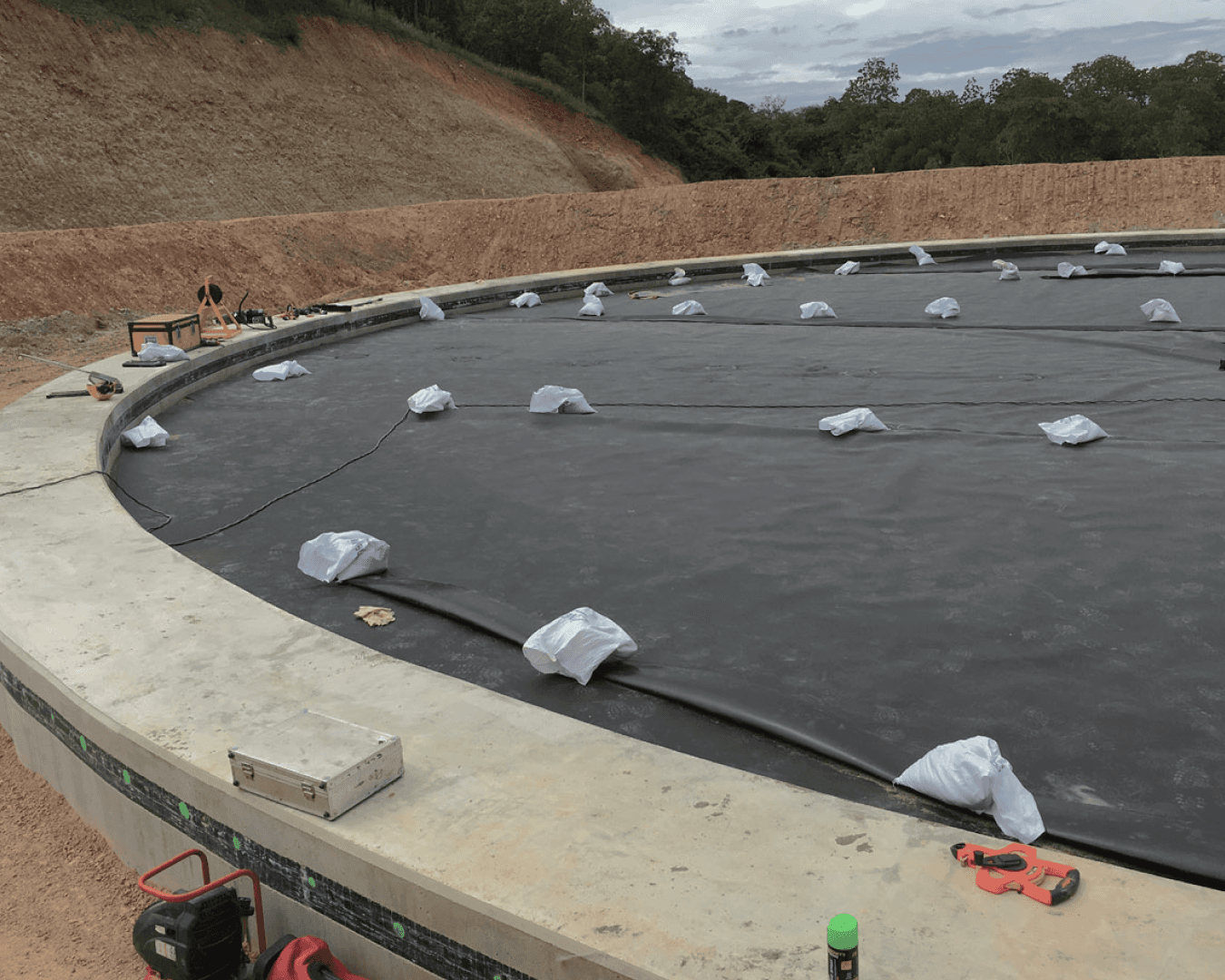
Secondary containment systems for fuel storage are typically formed as a bunded enclosure surrounding the tank. These bunds may be constructed from concrete, steel, or earthen materials, and in many cases an HDPE geomembrane liner is specified as the primary barrier within the bund.
Concrete is porous and will absorb hydrocarbons over time; untreated concrete bunds are not reliably impermeable to fuel. Earthen bunds, unless lined, will allow fuel to migrate into the soil. HDPE geomembrane, by contrast, offers excellent resistance to diesel, petrol, and lubricating oils, does not absorb or degrade on contact with these substances, and can be welded to form a continuous, seam-tested barrier across the base and walls of the containment area.
For above-ground tank installations, the liner is typically installed across the floor of the bunded enclosure and up the inner face of the bund walls, with the top edge mechanically fixed and sealed. Any penetrations through the liner — drainage outlets, pipe entries — are welded and sealed. As with all HDPE geomembrane installations, every weld is non-destructively tested before the system is put into service.
The Fuel Security Context
The New Zealand Government released a Fuel Response Plan 2026 in response to fuel supply uncertainty driven by the conflict in the Middle East. New Zealand imports all of its refined fuel following the closure of the Marsden Point refinery in 2022, and the Minimum Stockholding Obligation that came into force in January 2025 — requiring importers to hold a minimum of 28 days of petrol, 21 days of diesel, and 24 days of jet fuel — is the first formal onshore stockholding requirement New Zealand has had.
For individual operators, the supply uncertainty has prompted reassessment of on-site fuel reserves. Increased on-site storage, however, does not change the legal framework — it heightens the importance of compliant secondary containment. An operator who increases their storage from 800 litres to 2,000 litres in response to supply uncertainty crosses the compliance threshold in doing so.
What to Check
For any operator storing diesel or petrol above 1,000 litres, the key questions are: Is a compliant secondary containment system in place? Does the containment volume meet the 110% requirement? Is the containment system genuinely impermeable — or is it an unlined earthen or concrete bund that may allow fuel to migrate? Has the system been assessed and certified where required? Is the fill point also contained?
If the answer to any of these questions is uncertain, a compliance certifier assessment is the appropriate starting point. WorkSafe NZ's website provides guidance on secondary containment requirements and a calculator tool for determining the required containment volume for specific storage configurations.
Summary
Secondary containment for fuel storage is a legal requirement for most commercial and agricultural operators in New Zealand, not a discretionary investment. HDPE geomembrane lining is one of the most reliable methods of providing an impermeable containment barrier within a bunded enclosure — resistant to hydrocarbons, weld-testable, and durable over the long term. As on-site fuel storage volumes increase in response to current supply uncertainty, now is a practical time for operators to review whether their containment arrangements are compliant and fit for purpose.