08.01.2025
6 mins
As New Zealand's urban land supply tightens and development increasingly occurs on former industrial, commercial, or filled sites, sub-slab gas and vapour barriers have moved from a specialist application to a mainstream design consideration. For engineers and developers working on brownfield or contaminated sites, understanding when a gas barrier is required — and what that means for design, specification, and installation — is essential.
What Is a Sub-Slab Gas Barrier?
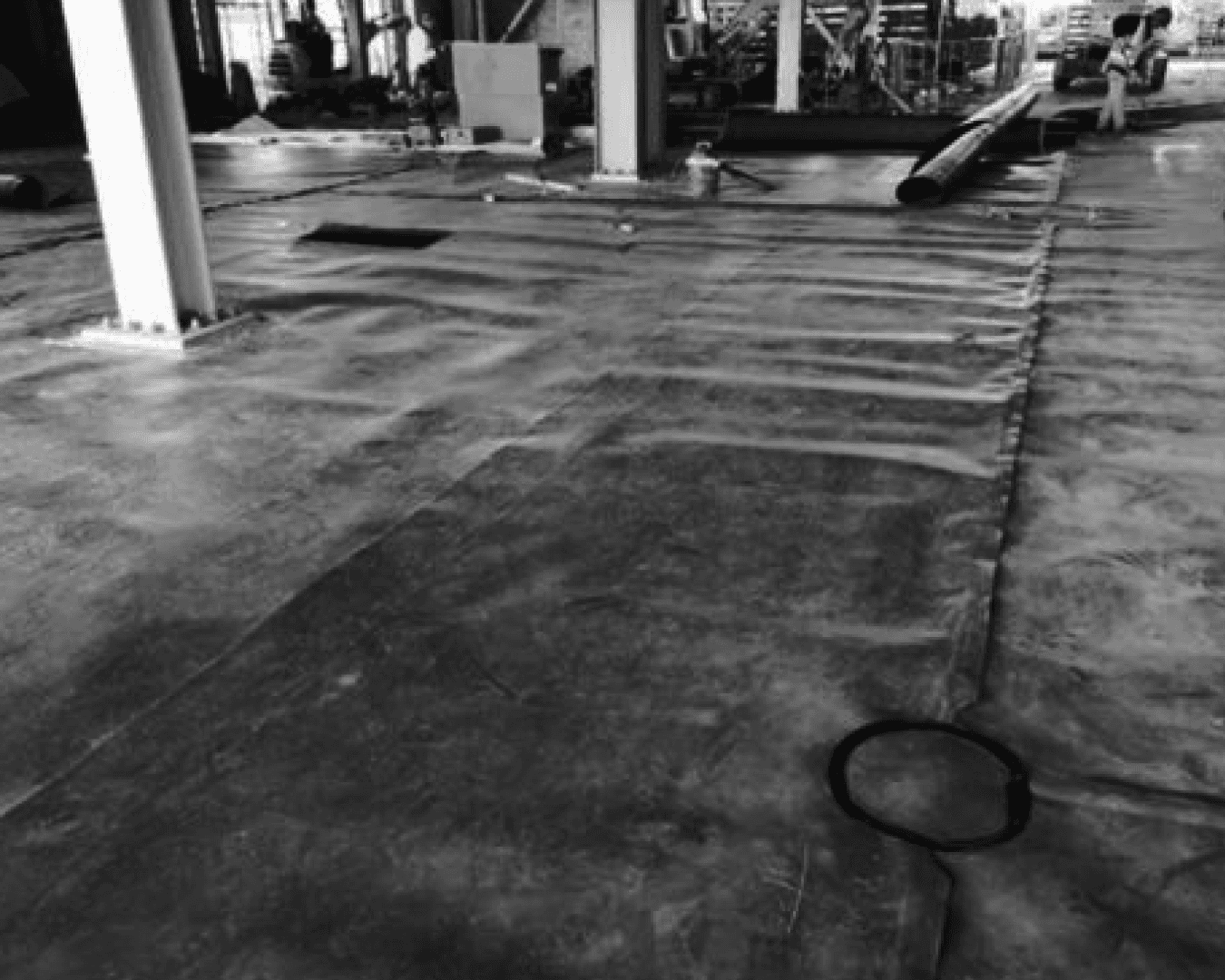
A sub-slab gas barrier is a continuous, impermeable membrane installed beneath a building's concrete slab to prevent the upward migration of gases from the ground into the occupied structure above. The gases of concern are typically those arising from contaminated ground, including volatile organic compounds (VOCs), landfill gas (a mixture of methane and carbon dioxide), and other site-specific contaminants arising from former industrial or agricultural activity.
The distinction between a damp-proof membrane and a gas barrier is important. A standard damp-proof membrane — as required under NZBC Clause E2 (External Moisture) for slab-on-ground construction — is intended to prevent moisture vapour transmission, not to provide a reliable gas-tight barrier. Standard DPM products have significantly higher gas permeability than HDPE geomembrane and are not appropriate for sites where gas ingress is a genuine risk.
HDPE geomembrane, typically specified at 1.0 mm to 1.5 mm for gas barrier applications, offers a permeability coefficient orders of magnitude lower than standard DPM materials and — critically — can be thermally welded at all joints and penetrations to create a continuous, verified barrier.
When Is a Gas Barrier Required?
The requirement for a sub-slab gas barrier is typically identified through a site contamination assessment conducted in accordance with the Ministry for the Environment's guidance on contaminated land management. Where a Detailed Site Investigation (DSI) identifies the potential for ground gas or volatile contaminants to affect a proposed building, the site remediation or risk management approach may specify a gas barrier as part of the ground engineering solution.
Sites that commonly require gas barrier consideration include former industrial and manufacturing sites, land adjacent to or formerly occupied by landfills, sites with fill of uncertain origin, and sites in areas of known ground contamination. With increasing development activity on former industrial land in Auckland and other major centres, gas barrier requirements are becoming more common in urban construction projects.
Design Considerations
The design of a sub-slab gas barrier system involves more than simply specifying a liner product. Penetrations — every service penetration through the membrane — must be detailed carefully with welded collars or boots to maintain barrier continuity. All field seams must be thermally welded by competent personnel and non-destructively tested. The membrane must be anchored and sealed at the perimeter of the slab. And the gas barrier must be coordinated with slab reinforcement, underslab drainage, and any radon sump systems specified.
A formal Design and Build basis for HDPE geomembrane installations on construction projects in New Zealand may reference NZS 3916, which governs design requirements for such systems.
Installation Quality and Testing
The performance of a sub-slab gas barrier is entirely dependent on installation quality. A correctly specified HDPE membrane installed with a single undetected leak at a welded seam or penetration detail will fail in its primary function. This is why non-destructive testing of every weld is standard practice for reputable geomembrane installation contractors.
For dual-track fusion welds, the air channel between the two bond tracks is pressurised and monitored for pressure drop. For extrusion welds at penetrations and patches, spark testing is used. Both methods provide 100% coverage of the installed seam length. Documentation of test results forms part of the installation quality record and should be retained as part of the project's as-built documentation.
Summary
Sub-slab HDPE gas barriers are a reliable and well-proven solution for managing ground gas risk on brownfield and contaminated sites. The key to a successful installation is the combination of correct specification, experienced installation, and verified seam quality across the entire membrane area. On projects where ground gas is a genuine risk, the consequences of barrier failure make the investment in quality installation worthwhile.