24.11.2025
6 mins
Walk the basement level of any recently consented commercial building in Auckland, and there is a reasonable chance you will find a stormwater retention tank. It may be purpose-built concrete, a modular plastic crate system wrapped in geotextile, or an earthen void — but it will be there, because Auckland Council's planning framework increasingly requires it to be.
HDPE geomembrane lining is one of the methods used to provide these tanks with reliable, long-term containment integrity. This post explains the regulatory context, the design applications, and why liner quality matters in underground stormwater retention.
The Regulatory Context: Auckland's Stormwater Management Area Overlay
Auckland's Unitary Plan introduced the Stormwater Management Area Flow (SMAF) Overlay as a mechanism to manage the effects of urban development on the region's streams and waterways. In natural catchments, a significant proportion of rainfall infiltrates into the ground. In developed urban areas, impermeable surfaces dramatically increase the proportion of rainfall that runs off, overwhelming the stormwater network and causing erosion, flooding, and ecological damage in receiving streams.
Sites within the SMAF overlay must provide both retention and detention of stormwater. Sites within SMAF Flow 1 and Flow 2 areas must provide retention of at least 5mm runoff depth across the related impervious area, together with detention of the difference between pre- and post-development runoff volumes from the 90th to 95th percentile 24-hour storm event. Auckland Council also requires stormwater detention on all new and redeveloped commercial and industrial sites where hard surface thresholds are exceeded.
Carpark Retention Tanks
Basement and at-grade carparks are among the highest-impervious-density land uses in urban development. The engineering response — increasingly common on larger commercial projects in Auckland and other New Zealand cities — is to incorporate an underground retention tank beneath or adjacent to the carpark slab. These tanks collect stormwater runoff and release it to the council network at a controlled rate, or retain it for reuse in toilet flushing and irrigation.
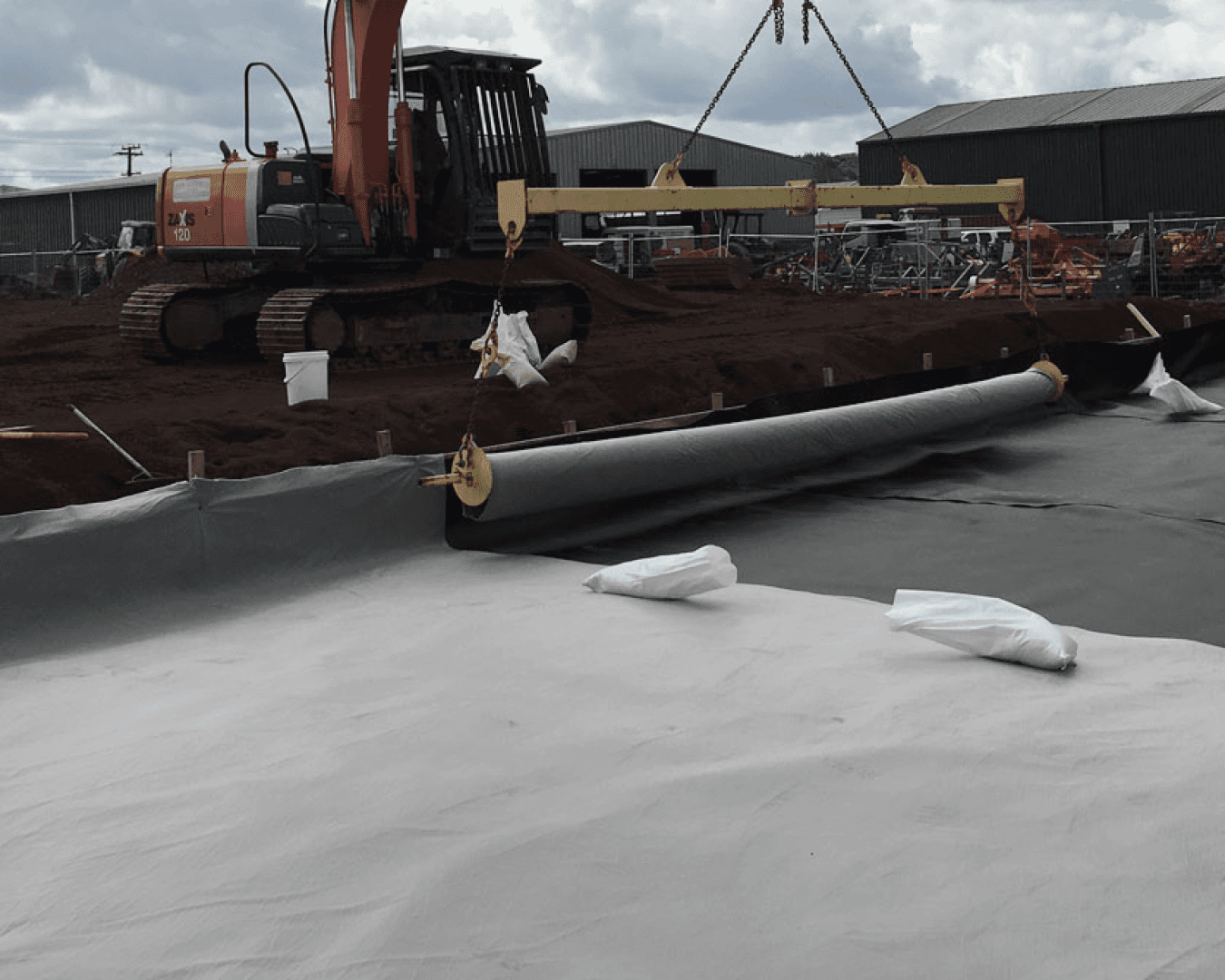
The structural form varies. On some projects, the tank is formed within the basement structure using concrete walls and slabs. On others, a discrete void is created using modular geocellular crate systems surrounded by imported fill. In both cases, an HDPE geomembrane liner may be specified as the primary water-tight barrier.
Why HDPE Lining?
Concrete is not inherently water-tight and relies on admixtures, coatings, or separate membrane systems to prevent water migration. For modular geocellular crate systems, an HDPE liner is the primary containment mechanism — the crate structure provides volume and load-bearing capacity; the liner provides the impermeability.
The advantages mirror those in other containment applications: chemical resistance to carpark runoff contaminants including hydrocarbons and suspended solids; long service life appropriate to the design life of the building; and weld integrity that can be tested and documented before the tank is backfilled and the verification opportunity is lost. Once a geocellular crate system is backfilled and the slab is poured, access to the liner for inspection or repair is effectively impossible without significant demolition.
Design and Specification Considerations
Engineers specifying HDPE-lined stormwater retention tanks should consider liner thickness — typically 1.0 mm to 1.5 mm for stormwater applications, with thicker material warranted where traffic loading or ground movement is a concern. Anchor details at the top of the tank require careful design to prevent the liner from lifting when the tank is drawn down. Penetrations for inlet, outlet, and overflow pipework must be detailed with welded collars to maintain barrier continuity.
Looking Ahead
As Auckland's development continues to intensify and the SMAF overlay extends to cover more of the urban area, underground stormwater retention will become an increasingly standard component of commercial construction. Similar stormwater management requirements are also emerging in other New Zealand councils in response to both legislative obligations and the demonstrated impacts of increasing urban imperviousness. For developers and engineers, understanding the stormwater management obligations that apply to a site — and factoring underground retention into the design programme early — will avoid the cost and delay of redesign at a later stage.